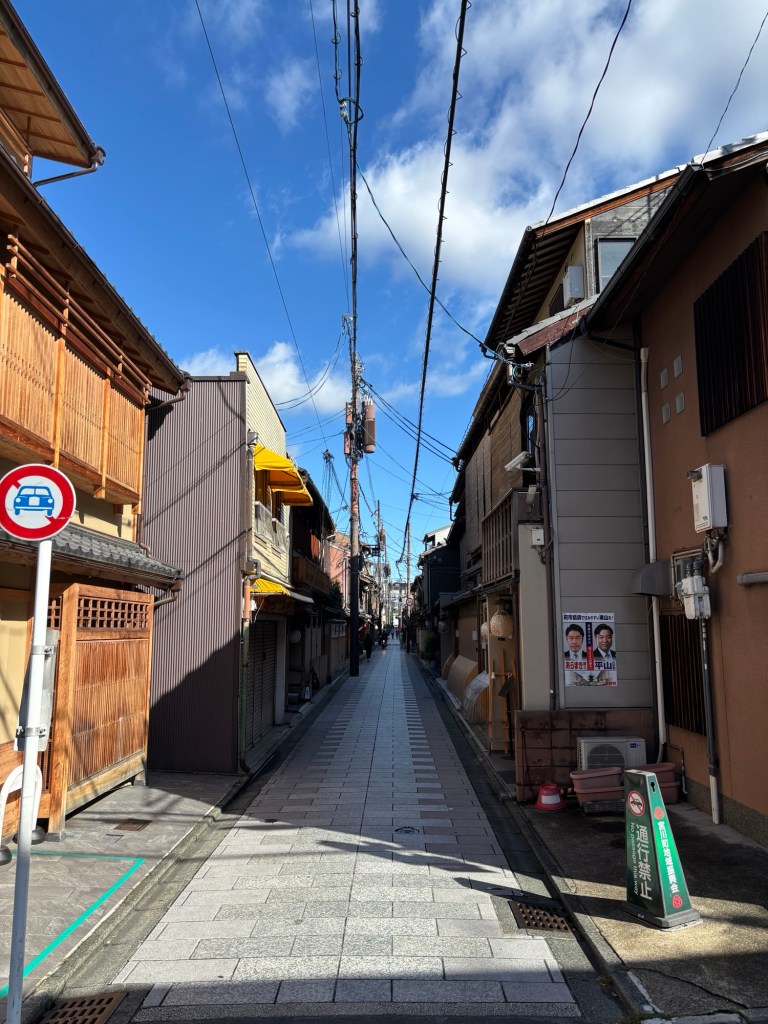
In the year 794 Emperor Kanmu chose Kyoto as the new seat of Japan’s Imperial Court. This would be the capital of Japan until 1869 as the Meiji Resoration began. The modern city was established in 1889 and survived the Second World War mostly unscathed. As a result many important sites including numerous temples and shrines can still be found in Kyoto as well as charming neighborhoods with very narrow streets.
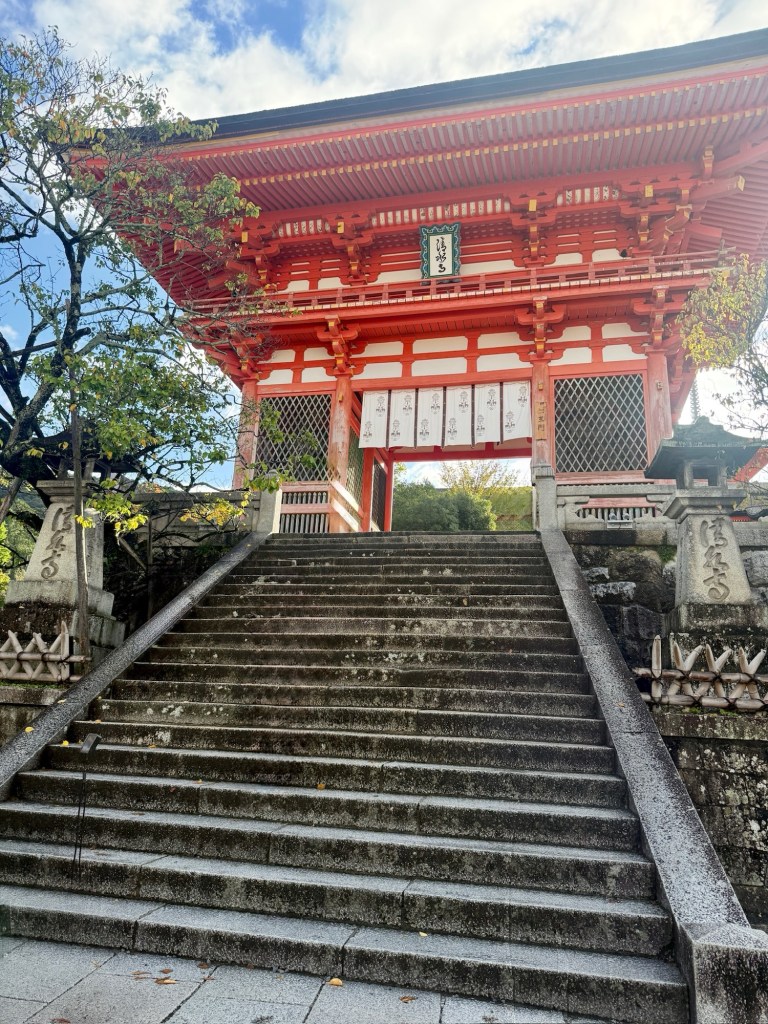
In the year 778 (16 years before the Imperial Court moved to Kyoto) a monk had a dream that led him to Mount Otawa. When he arrived he met a white robed ascetic praying to Senju Kannon. The ascetic then said, “I have waited many years for you to come. I am now leaving for the eastern provinces, so I leave the rest to you.” The monk realized this was a reincarnation of Kannon, the bodhisattva, the lord of compassion, and tbe goddess of mercy. The monk carved a statue of Kannon and placed it in the ascetic’s hermitage, which was the first site of the Kiyomizu-dera which we visited today.
There’s more to the story, of course, but this is a blog post, not an essay. From the temple, a path called the Sannenzaka leads back down the mountain, including a long patch of stone steps which take three years off your life if you fall (or note that you will die in three years).
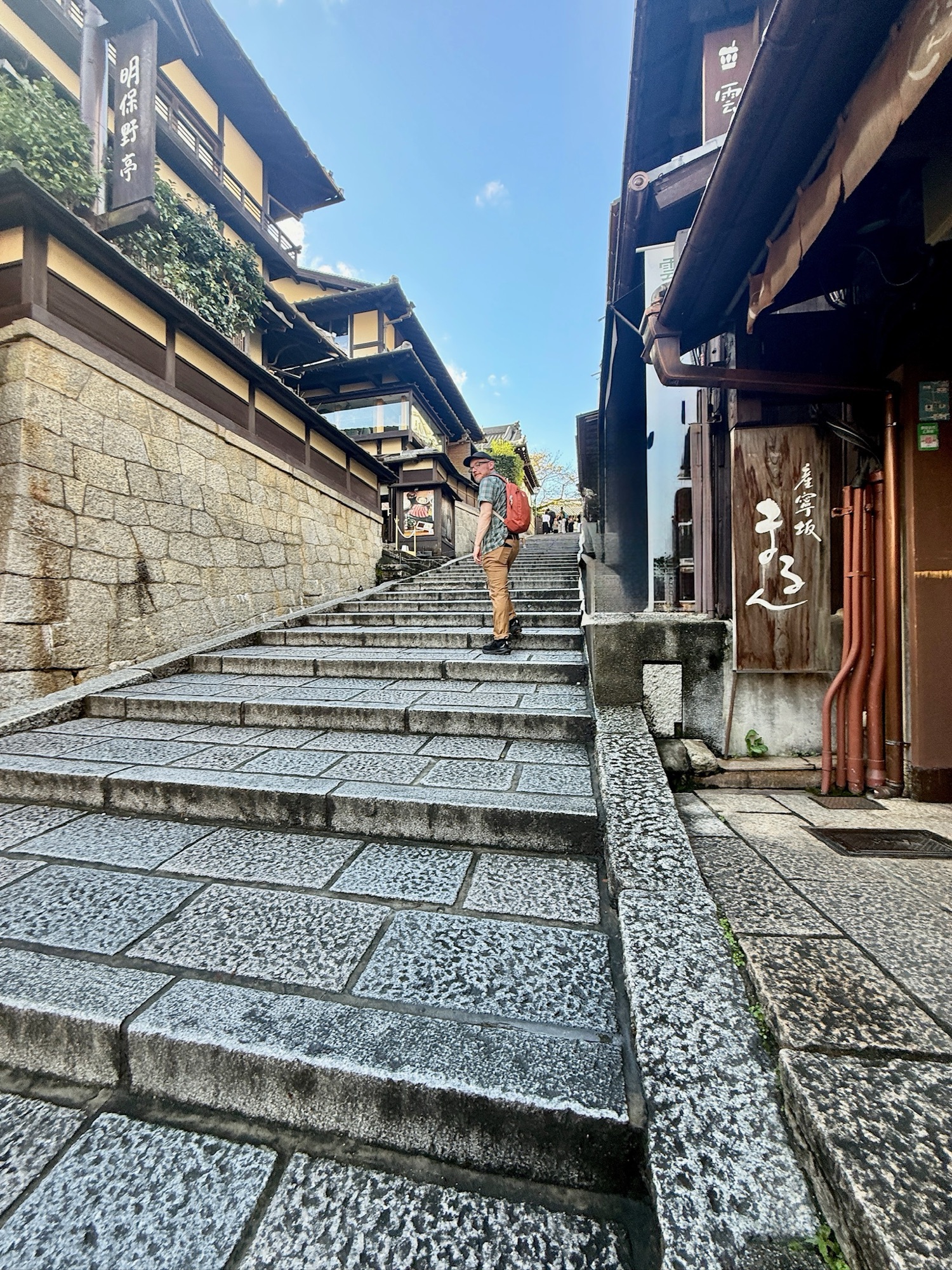
Apparently one can purchase a luck giving gourd to help restore one’s life if unsteady on the steps. This led to the proliferation of shops specializing in these gourds and their replicas along the side of the road over the years. Now the shops are filled with typical tourist fare.
Luckily, I kept my balance. The challenge these days is to not literally trip over a tourist. We were only contributing to the problem, but it is a UNESCO heritage site so it is humanity’s shared heritage, right?
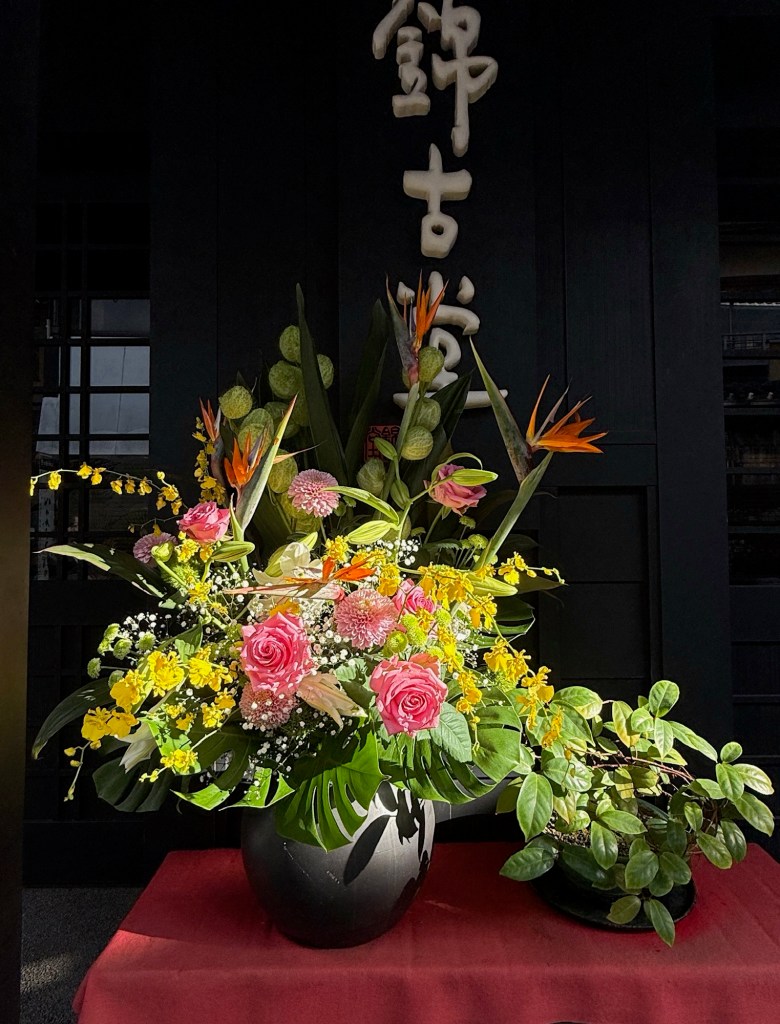
My Lady took this picture. No filter. It’s some amazing work but was just on the side of the path. The light was just fantastic.
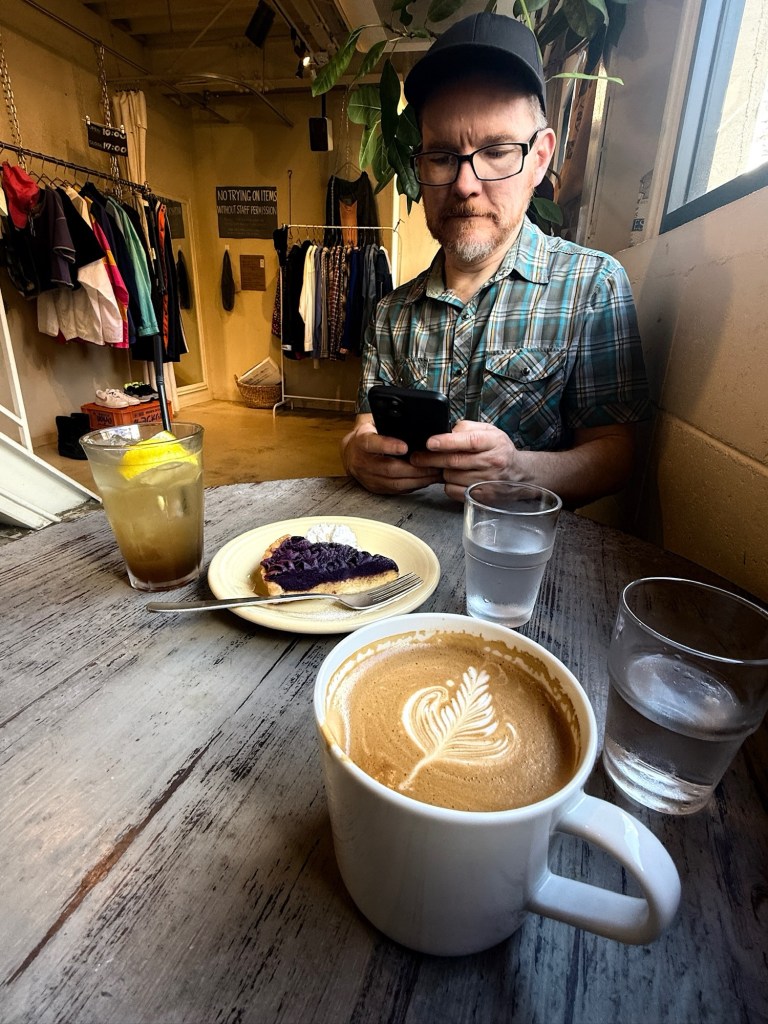
My Lady also took a much better picture than the one I captured in this moment at Kamee Coffee for a quick treat after all the walking and not tripping. There’s a little thrift store element one can see behind me in this reclaimed warehouse across the river.
I looked up Kamee, realizing they had three locations in the city . Concerned they are a corporate chain I was partially relieved to discover they are more like a Los Bagels or Ramones of Kyoto. So they pay their young staff maybe a little over minimum wage and get that aura of cool that sells their specialty purple sweet potato pie and expertly made espresso drinks. But I’m not one to criticize. I can only afford to pay a little over minimum wage at my bookshop at the moment.
We stopped by a couple bookshops (one was closed) as we continued a walk through Kyoto. Finally we lunched at Gion Soy Milk Ramen Uni Yukiko. The gluten free fare was delicious and filling.
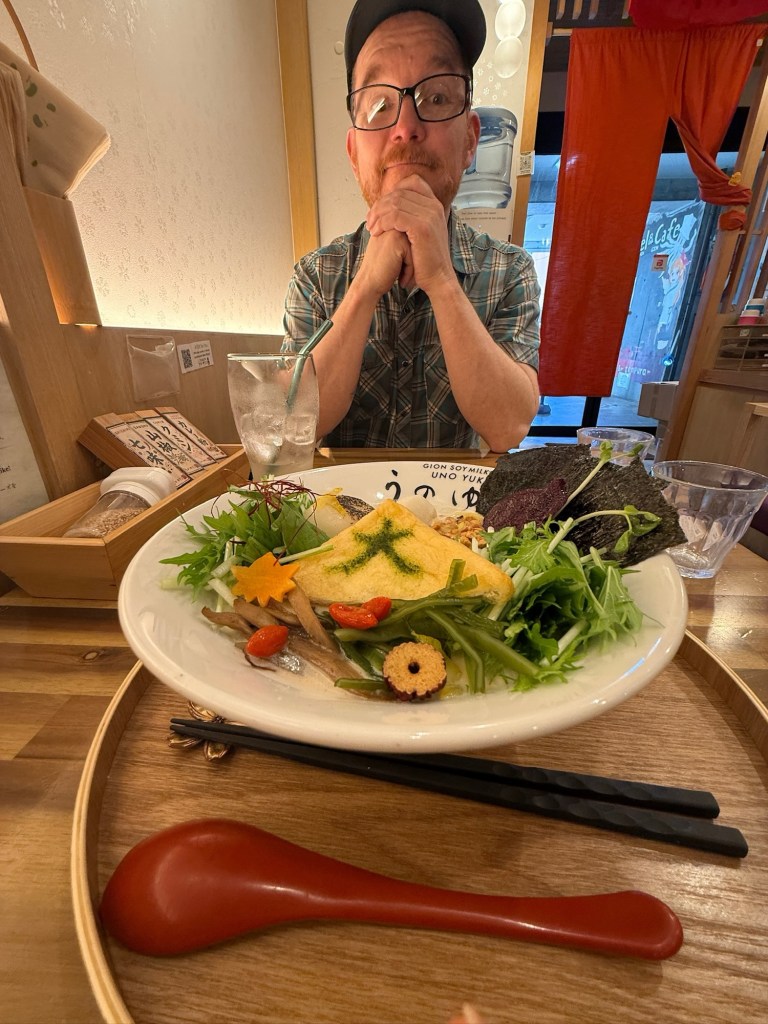
One little feature that intrigued me was the ordering with QR code on our phone. That’s around some places in the States, but it is prevalent here. After we were done eating we took the card with our table number specific QR code to the register to pay. The card was in a little protective case, like one might use for a precious and rare Pokémon card, which is appropriate as Nintendo is headquartered in Kyoto.
It’s these little design elements that catch my eye. I’m sure others have more knowledge and have spent time studying the efficiencies and improvements to customer experience that such design choices affect.
Napping is apparently my superpower. It has become crucial to cranking out a productive morning then going out again in the afternoon or even evening as we did this night. If I’m going to continue waking up at 4 am and going to the hotel gym, then I’m not going to feel bad about sleeping a little in the afternoon.
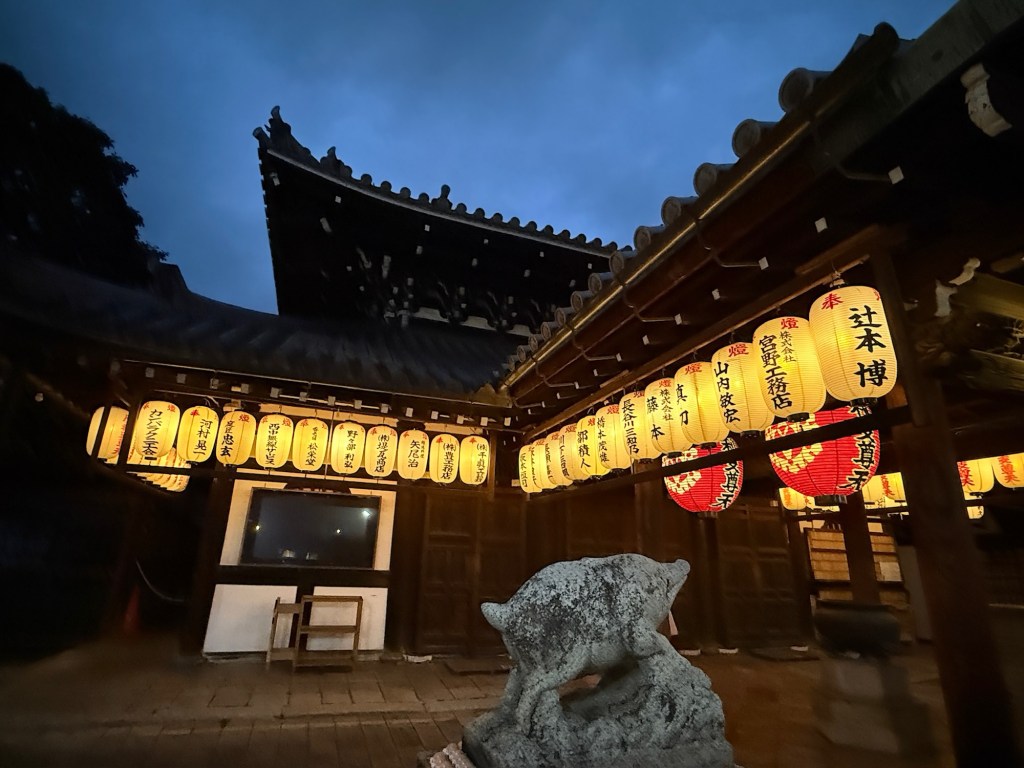
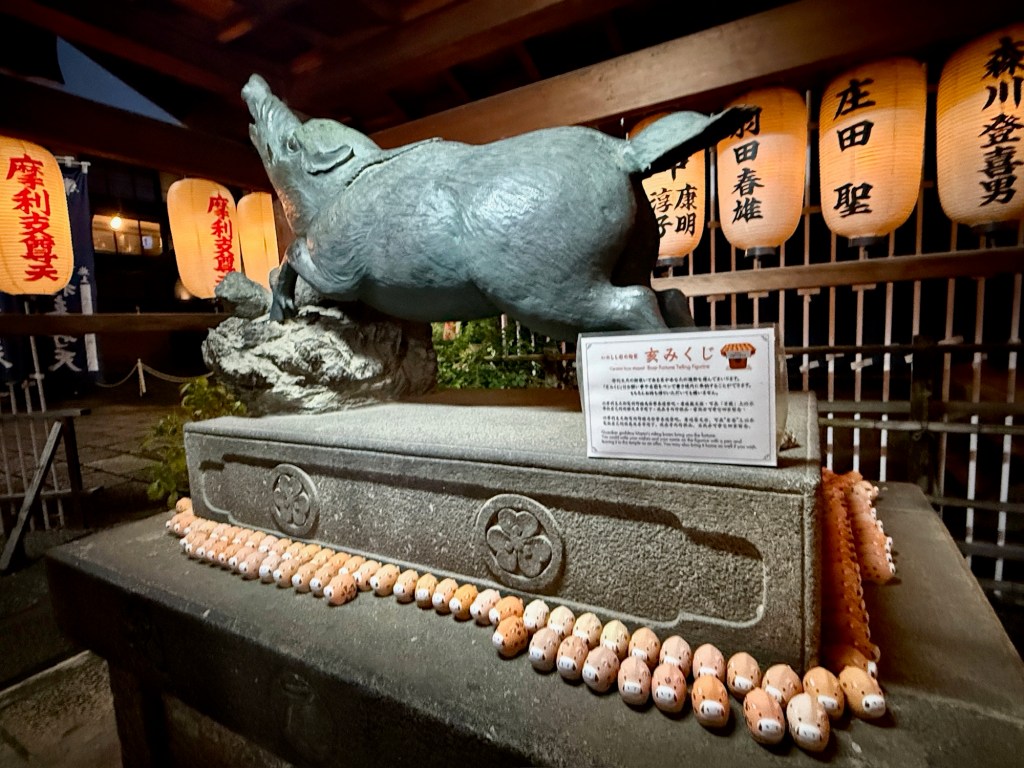
There are temples throughout the town, literally every few blocks in some part of town. This Buddhist temple had an abundance of boar iconography. One can take a tiny ceramic boar sculpture or write a name on it and leave it for good luck. In any case, one should leave a donation which helps with upkeep of the temple.
We walked through the charming streets and found the major shrine in the Gion District.
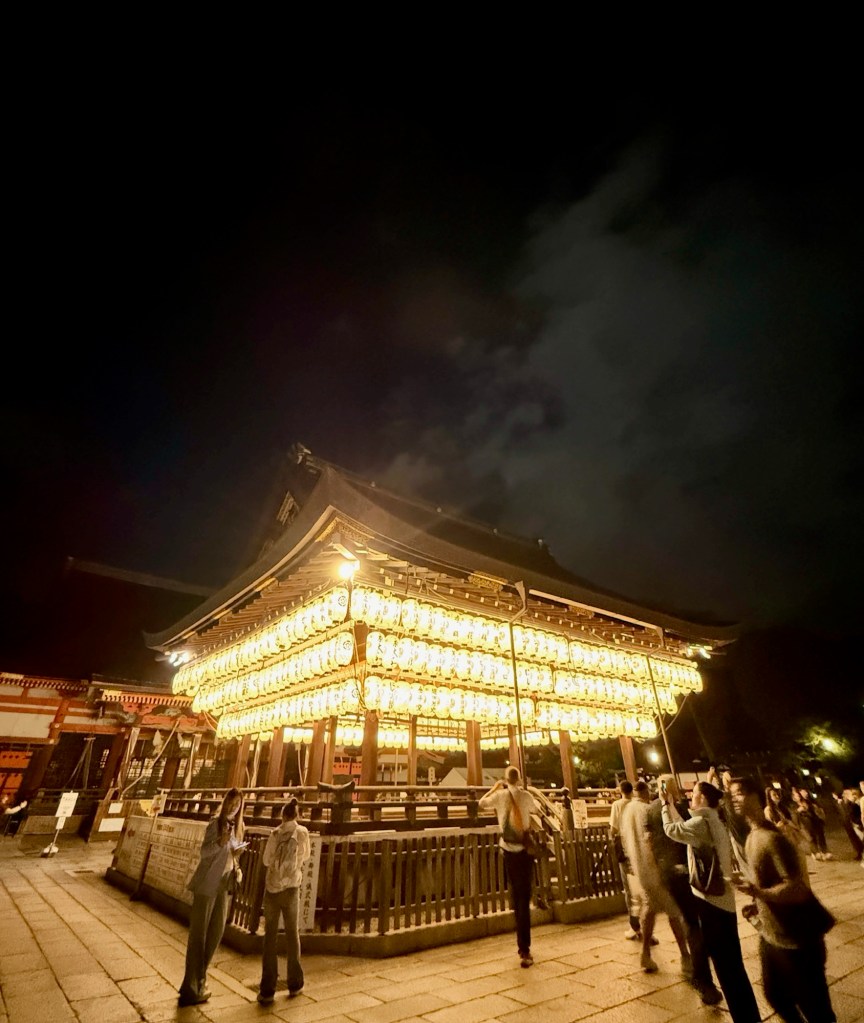
The Yasaka Shrine is a Shinto Shrine dedicated to the Kami Susanoo, the brother to Amateratsu (goddess of the sun and mythical ancestress of the Imperial Line). The shrine was built in the year 656. Susanoo has some complicated history, but is said to have defeated a dragon so he’s that kind of cool.
Again, there is an exceeding amount of history, including the separation of Buddhism and Shinto by the state claiming Shinto as a non-religious moral and patriotic practice during the Meiji Restoration. There is so much politics involved that I will keep it simple here and defer to experts on the subject.
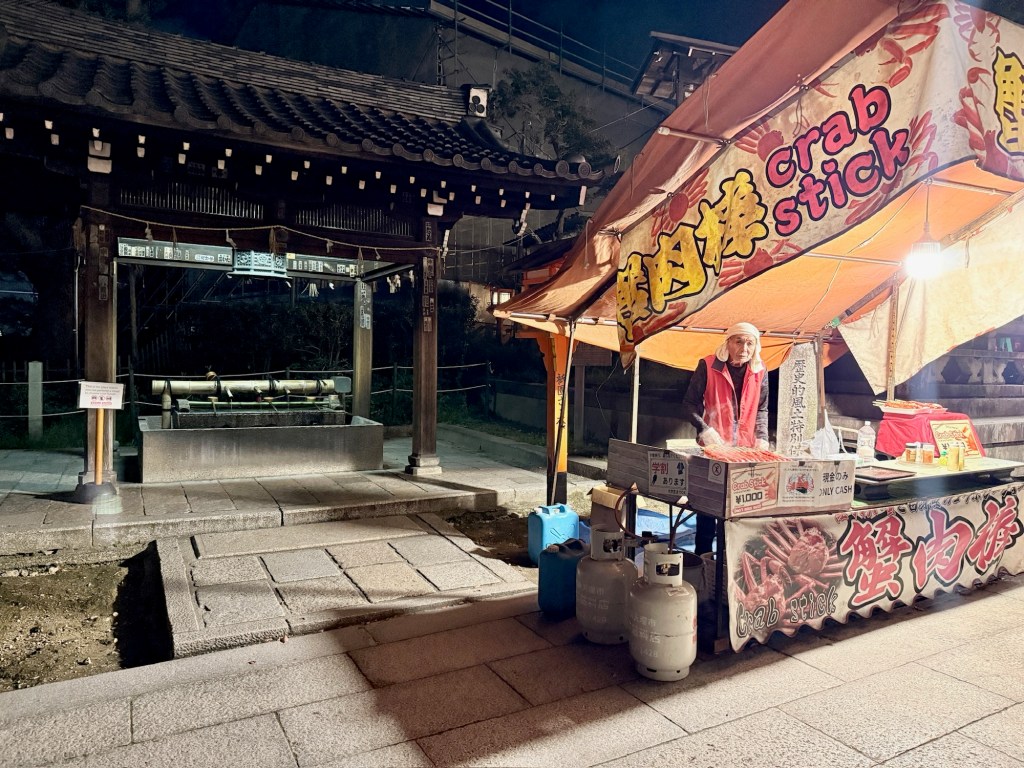
We got a kick out of this older gentleman selling crab sticks at the shrine right next to the purification station. There was a long line of vendors on the path selling all kinds of food and some trinkets.
So much of this area of Kyoto is focused on tourists. The narrow streets and lanterns out at night is quite romantic. If it weren’t for the thousands of tourists from all over the world, it would be quite charming. To be honest, it is still charming.
I’m attempting to imagine when it was not overrun by tourists and a traveler could walk through the streets and feel like they were getting a genuine experience. 30 years ago? 40? 50?
After a little research, I read that the Abe Administration began pursuing tourism in 2013, so before that, I suppose, was the best time to travel to Japan from a cultural perspective. Certainly, the earlier the better, but I’m assuming the excesses of tourism ramped up then.
Between 1995 and 2014 Japan was the least visited country in the G7, so maybe that would be a good time to see whatever innovations the people of the country were making while seeing more historical sites with less foreigners around. But it was also expensive at the time. Now we are really enjoying how inexpensive everything seems to us.
Now we can just use AI to erase the other annoying tourists (unlike us, of course).

