Flying to Japan is a physically challenging journey. We were up for about 24 hours and tried to get on the Tokyo schedule by going to sleep close to a reasonable local time.
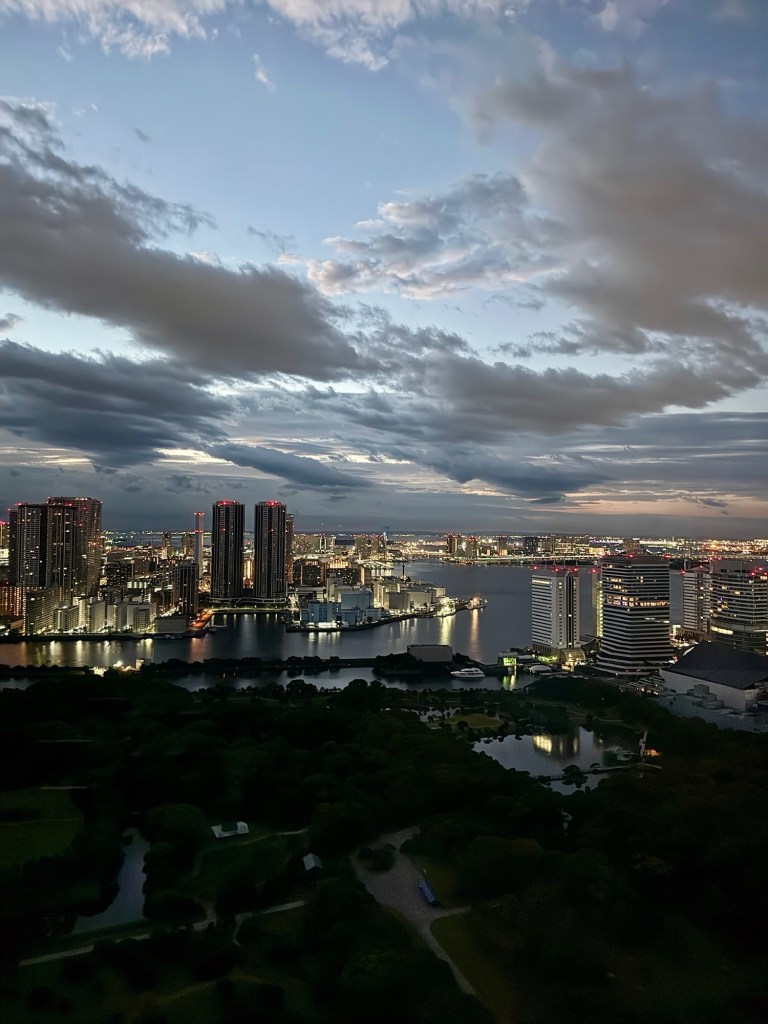
We were feeling pretty good as the sun rose over Tokyo Bay (above is our view) despite a less than ideal night of sleep. The jet lag would catch up to us and force a midday break back at the hotel later, but we walked a bit in the morning.
The Tsukiji Outer Fish Market is iconic and reminded me of Fisherman’s Wharf in San Francisco where my stepfather had a street flower shop for fifteen years. It is truly a working market but so much of it is for tourists who fill the area, especially in the morning when so much else in Tokyo is not open yet.
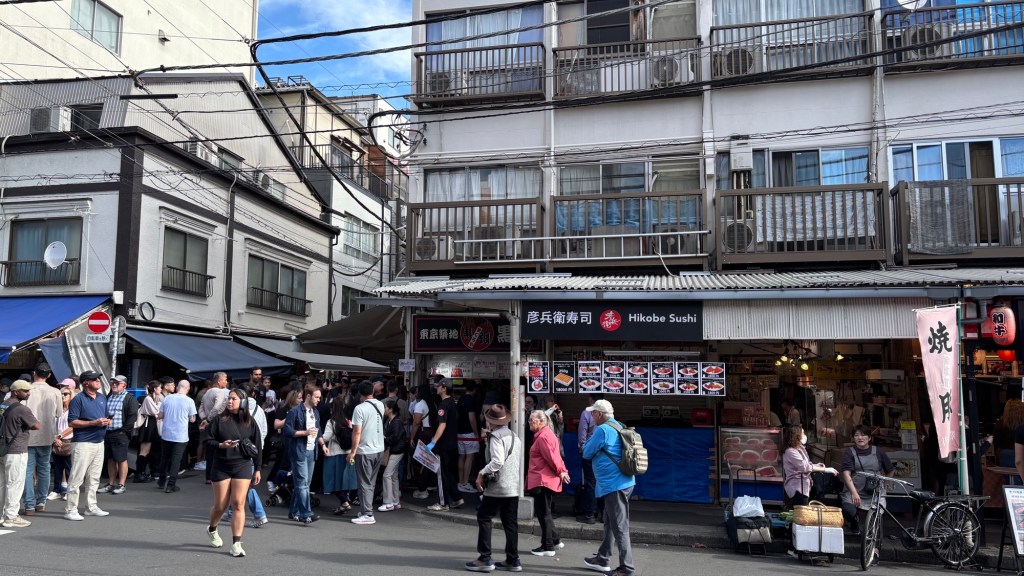
What is a place for? It can be for selling fish and for visitors hoping to see some genuine life while they explore an unknown city. I wonder about the folks who live in the apartments above the neighborhood. Maybe it’s because I live above my bookshop in our small town’s tourist focused area.
So much of my business at the bookshop is dependent on tourists. I like talking with them but I am glad we have regular folks who come in and meet a basic need in a local way. Travel is good to help give people perspective and I get to be on both sides of that.
Next to the fish market a huge area has been cleared for some major development and we happened to end up with a view of their morning 9 am meeting from above.
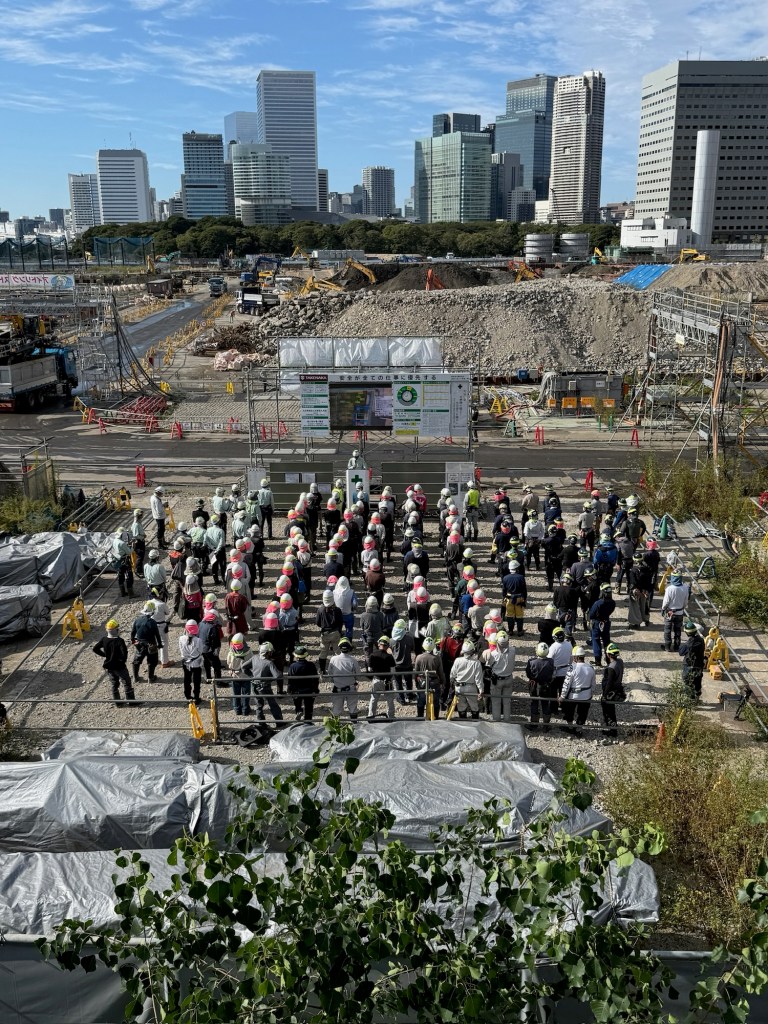
It’s fascinating seeing this largest city in the world as an expression of capitalist development which rivals all others. While there are cultural differences, the basic political economy is part of this worldwide dominant culture. It’s fascinating to see it all happening in a language other than that which I speak. Abroad I become most aware of my assumptions and ignorance of the rest of the world.
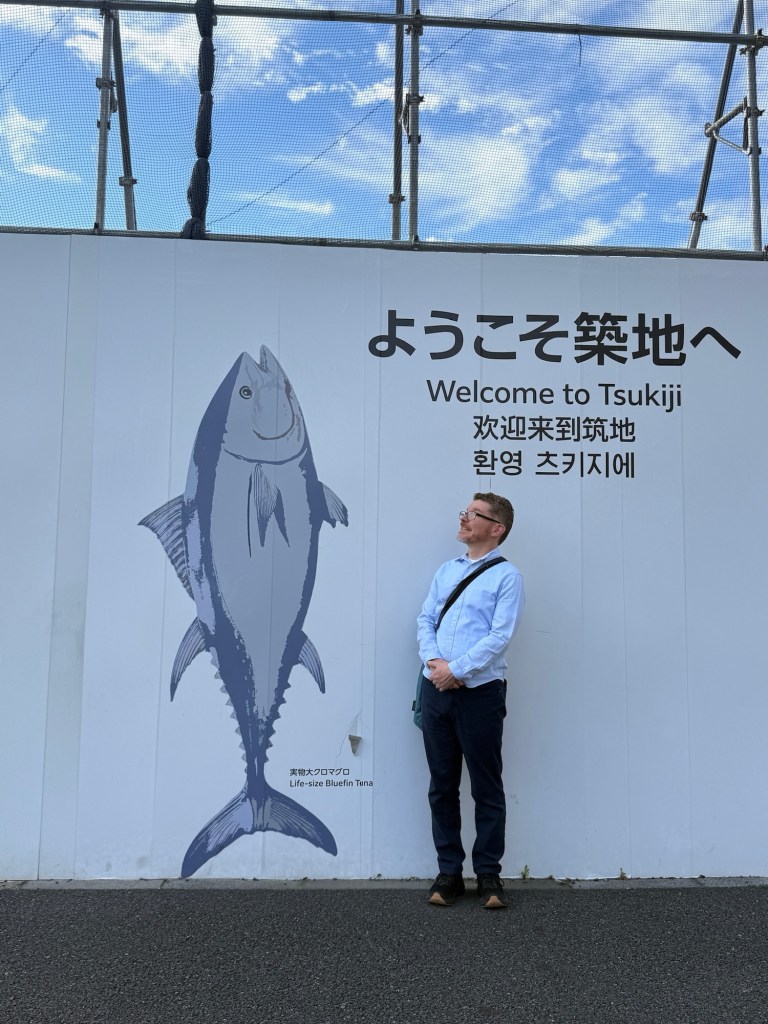
Outside the construction area many interesting interpretive signs and artwork, sharing history, generally accepted rules for the fish market (don’t haggle on price and hold your kid’s hand, for example), and an image to give you the idea of a full sized tuna. I love when someone planning for construction considers these things.
Beyond the construction workers meeting one can see the Hama-rikyu Gardens.
This beautiful and huge area was a family garden for the Tokugawa Shogun which functioned as an outer fort for Edo Castle. Several Shoguns made improvements over centuries until the Meiji Restoration when it became a detached palace of the Imperial Family and gained its current name Hama-rikyu Gardens. Less than a hundred years later the Imperial Family donated the garden to the City of Tokyo following the devastation of World War Two which destroyed much of the garden as well.
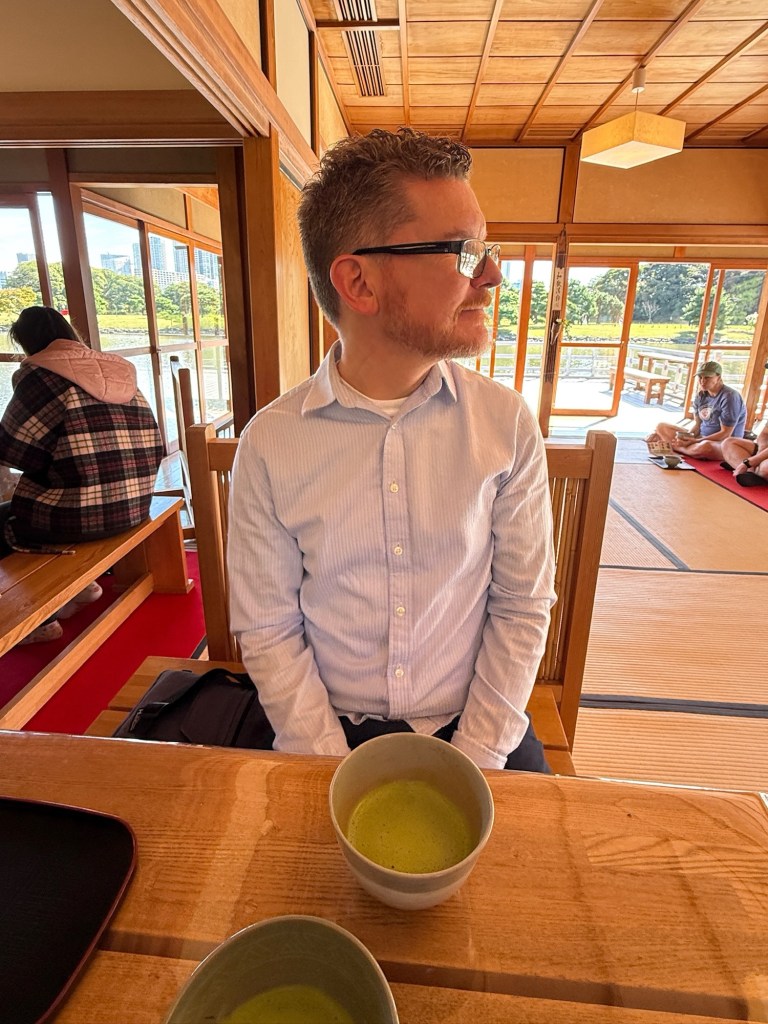
I had matcha tea at the restored tea house on the water. It was beautiful there despite matcha not really being to my liking. The flavors are complex and earthy while being served in a frothy medium. I understand why people would like it and can clearly see how adding a lot of cream and sugar would make it a favorite of Americans.
In this first day I already reflect on how I am a product of my upbringing, stunted as it was by a strange nationalism and belief in American exceptionalism which, even if I rejected, I ingested through my years as a publicly educated and pop culture inculcated child. I am still an American.
We saw herons and egrets on the water and heard a chorus of birds as we walked through the trees. And this is another perspective of travel. The natural world is the constant. Certainly there are differences in the animals, and even it is a product of the place we humans have created. (I swear the crows and ravens caws were influenced by the Japanese language.) In the end, clouds in the sky and the sound of water flowing cannot be surpassed by any such marvels as imagined by human minds. Instead, our greatest moments are found in harmonious interaction with these natural forces.
We enjoyed eating some treats from the conbini (convenience store) while sitting on a bench at the resting place next to the very small gift shop where we bought a stamp book to collect the stamps from different locations on the trip. We needed this moment of reprieve.
Break time back at the hotel (which is behind the gardens, behind the construction site in the image above) was relaxing before heading back out for a small adventure to end the day.
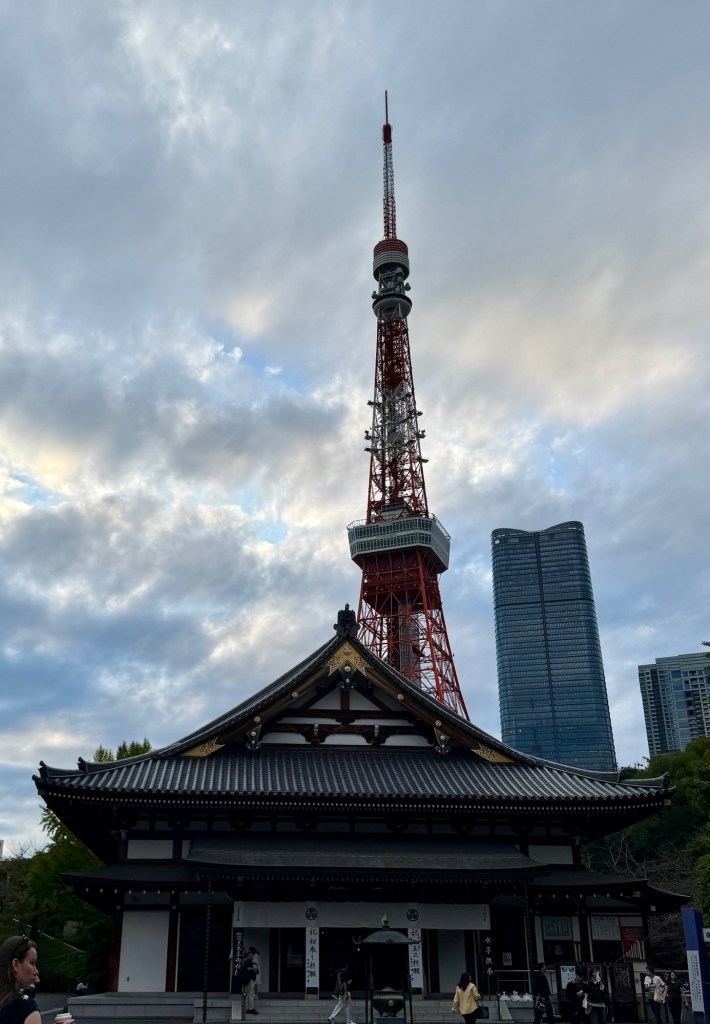
We walked to the Zojo-ji Buddhist Temple which sits near to the Tokyo Tower. It’s an obviously interesting juxtaposition.
I have so many feelings about visiting holy places where religious rites are performed, including Buddhist temples. I don’t think I have any well formed thoughts about it and the more I learn about and think about it, the less clear I become. So I won’t share my ramblings here.
The Zojoji Temple is the head temple of the Jodo sect of Japanese Buddhism in the Kanto Region. The grounds include a mausoleum of the Tokugawa family and a moving shrine to unborn children. The small child statues are dressed with little hats to keep their ears warm and people buy toy pinwheels for their spirits to play with. It’s rather touching.
The temple was originally built in the year 1393 and moved to its present location in 1598. Most of Zojoji’s current buildings are recent reconstructions except for the main gate, the Sangedatsumon, which has survived many fires, earthquakes and wars and dates from 1622. The time scale is so different here.
While these small areas of Japan contain many older remnants of time past I was struck by how new most things are. Preservation of some older locations was the exception rather than the rule.
We are looking forward to tomorrow when we hope to see the Imperial Palace, the gardens there and the Jimbocho neighborhood which boasts over 150 bookstores!
I feel lucky to be here.

