The following is a letter to the Eureka City Council who will be considering adopting a resolution to declare Eureka a “sanctuary city.” It has been crafted to fit in the three minute limit for public comments.
***
March 1st 2025
City Council Members,
I ask that you declare the City of Eureka a Sanctuary City.
The concept of welcoming the stranger may be familiar to many acculturated in the United States through their understanding of the holy texts of Judaism, Christianity, and Islam. However, the virtue in welcoming those not of your tribe has broad appeal among humans.
Through most cultures around the world the concept of welcoming the stranger has a central role. From the Japanese concept of Omotenashi which includes so much more than mere hospitality to the Indian Hindu-Buddhist philosophy of Atithi Devo Bhava which translates literally as “the guest is akin to god,” we can see the expression of the universal concept the ancient Greeks refer to as Xenia or “guest friendship.”
America was deliberately founded on Greco-Roman ideals which the secularly sacred spaces of our nation’s capitol and many state, county, and even city halls of legislation display. The concept of welcoming the guest was literally built into the foundation of our country as Xenia was an important part of Greek architecture.
One of the most evocative stories associated with the concept of Xenia is that of Baucis and Philemon, two humble elderly residents of Phrygia who unknowingly become hosts to the disguised gods Jupiter and Mercury, due to the rest of the wealthy townspeople not respecting the tradition of welcoming the stranger. Despite their poverty, Baucis and Philemon offer of the best of their food and give refuge to the travelers. Philemon chases their only goose in hopes of offering it to their guests, but the goose escapes to the safety of Jupiter’s lap. The god explains that the two hosts need not sacrifice the goose, but should instead flee the town. They travel with the gods to the top of a nearby hill and see the wickedness of their guest-denying city covered by a flood. Their home is transformed into a temple and they become the guardians therein. In death the two will embrace as they are to be transformed into an oak and a linden tree intertwined, at least according to Ovid who does a much better job of relating this story in Book 8 of his Metamorphoses.
The concept of being a gracious host is so ingrained in the culture of being a human, that to contravene this directive has lasting consequences. Our success as humans depends of lifting each other up to the high ground with Philemon and Baucis. The powers beyond our humble efforts — be they spiritual deities or the laws of nature they represent — reward our efforts at providing sanctuary, even when the multitude around us choose hard hearts and certain peril in the coming flood.
I invite you to join me and other citizens on Monday nights at Eureka Books where we review agendas of the deliberative bodies which affect our lives. If you want to also join the Classics Book Club, reach out to me.
***
Numerous artists have drawn on this story. Enjoy a few examples below.
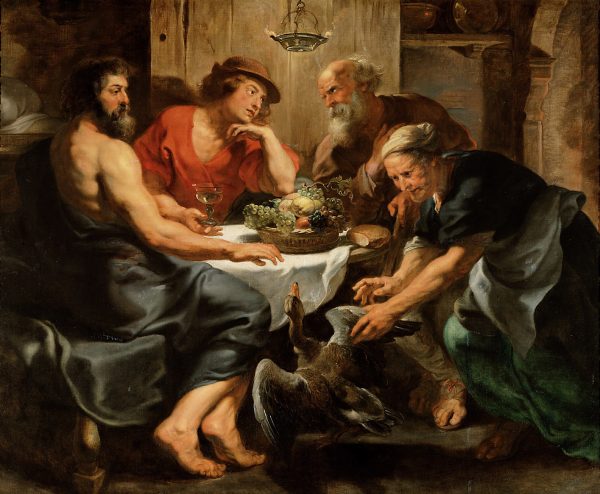
Image of Philemon and Baucis hosting Jupiter and Mercury by Rubens
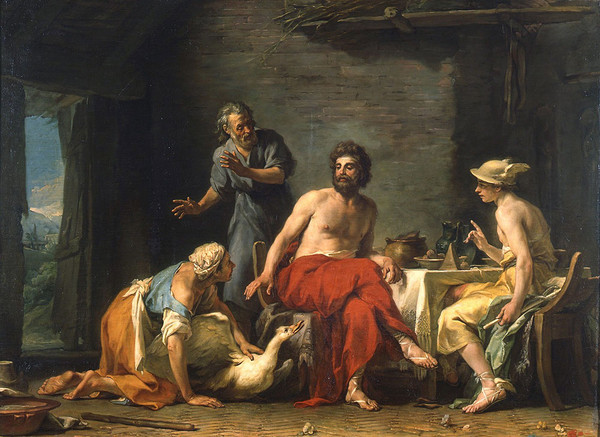
Image of Philemon and Baucis hosting Jupiter and Mercury by Restout
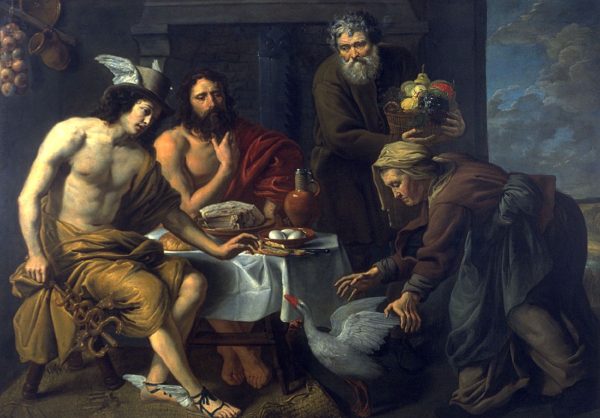
Image of Philemon and Baucis hosting Jupiter and Mercury by van Oost
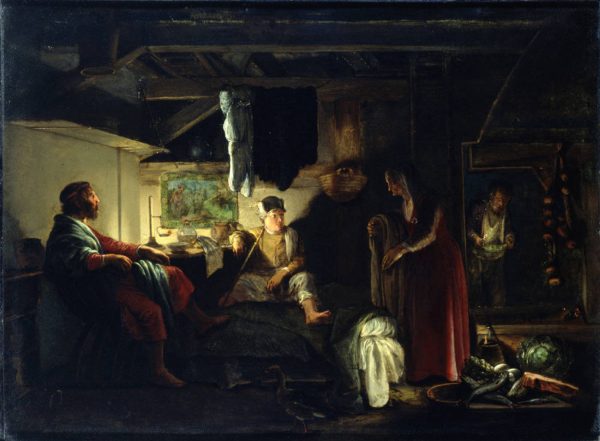
Image of Philemon and Baucis hosting Jupiter and Mercury by Elsheimer
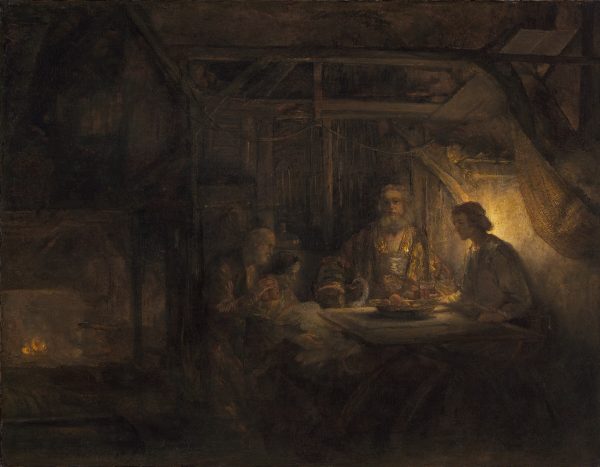
Image of Philemon and Baucis hosting Jupiter and Mercury by Rembrandt
I must say that the Rubens is my favorite for the evocative expressions on all four faces.
All these images and more of the subject matter can be found at the following link:
https://commons.wikimedia.org/wiki/Category:Philemon_and_Baucis
There are several delightful ones there. Be sure to note the placement (or absence of) the goose.
 Solomon Everta